

Best Fiber Laser Cutters for Small and Mid-Sized Sheet Metal Shops
A small sheet metal shop may cut repeat parts in the morning and prepare a custom order in the afternoon. Limited floor space, uneven workloads, and shared operator responsibilities complicate equipment selection. A laser cutting machine that takes too long to set up or leaves insufficient handling space can delay orders even when its cutting capacity is adequate.
This guide explains how workshop demands affect selection, what to examine when comparing fiber laser cutters, and how different configurations suit common production needs.
What Makes Laser Cutter Selection Challenging for Smaller Shops?
Several characteristics of smaller workshops make fiber laser cutters difficult to compare from specifications alone.
Small Batches and Frequent Job Changes
Short runs leave fewer parts over which to spread programming, material setup, and trial-cutting time. When these steps recur with each drawing change, faster cutting may produce only a limited improvement in order completion time. Preparation requirements therefore complicate comparisons based on cutting speed.
Fluctuating Workloads
Order volumes can change between busy and quiet periods. Capacity selected around peak demand may be underused at other times, while a configuration based on average demand may struggle with busy weeks. This uncertainty makes power and automation investment harder to assess.
Limited Staff and Workshop Space
Where one operator also loads sheets and removes parts, machine attendance requirements influence how much work can be completed. Compact premises add another constraint: a cutter may physically fit while leaving insufficient handling or maintenance space. Suitable cutting specifications can therefore involve quite different staffing and layout requirements.
Varied Materials and Parts
A shop may combine regular thin-sheet orders with occasional thicker parts or demanding contours. The machine needs to support routine quality and delivery requirements while accommodating less frequent work. The difficulty lies in deciding which capabilities deserve regular investment and which serve only occasional demand.
What Matters When Choosing Fiber Laser Cutters for Smaller Shops?
The main considerations are cutting capability, workshop space, ease of operation, and the cost of keeping the equipment in use.
Materials, Thickness and Cutting Quality
The machine’s power and cutting capability need to suit the materials and thicknesses used in regular orders. Its ability to maintain dimensional accuracy, well-formed holes, and clean edges also matters. These results affect whether parts meet customer requirements and how much manual finishing is needed after cutting.
Laser Cutting Machine Size and Layout
The working area determines which sheet and part sizes the machine can accommodate. Overall dimensions, loading space, and maintenance access determine its installation requirements. For a smaller workshop, a suitable layout leaves enough room to move materials and remove finished parts without obstructing other operations.
Programming, Changeovers and Part Handling
Clear programming and nesting tools, reusable cutting settings, and understandable controls can reduce preparation effort when jobs change. Remnant recognition and part-separation features can also help with material reuse and removal after cutting. Their usefulness depends on how often these tasks occur in the shop’s normal orders.
Operating Costs, Maintenance and Support
Assist gas, consumables, operator time, and routine maintenance contribute to the cost of each order. Servicing requirements also need to be manageable for the available staff. Operator training, spare-parts supply, and technical support are particularly relevant when the shop has limited in-house maintenance resources.
Best Fiber Laser Cutters for Small and Mid-Sized Sheet Metal Shops
The three Hymson models below offer different combinations of preparation tools, cutting-process functions, and configuration options.
Hymson HyLaser 3216 PRO — Best for Growing Production Needs
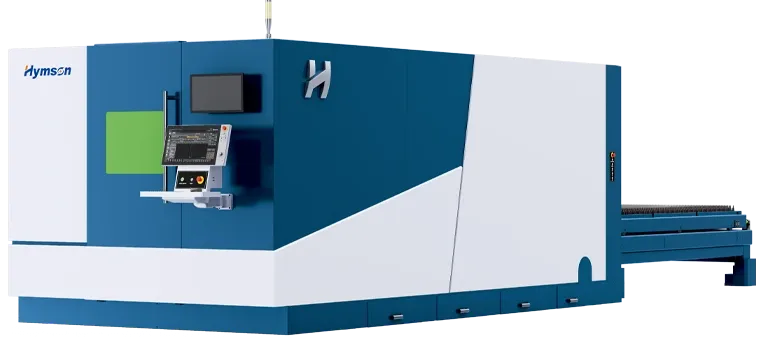
HyLaser 3216 PRO is the 3200 × 1600 mm model in Hymson Laser Machinery’s continuous-production range, intended for workshops with sustained cutting requirements.
Key Features and Benefits
- Auto Recut: Detects incomplete cuts and automatically recuts them, reducing the need for separate operator intervention.
- Smart Laser Off: Controls laser shut-off timing to support cleaner edges at contour completion.
- Smooth MicroJoint: Uses small micro-joints to simplify part separation while limiting visible connection marks.
- SkyEye remnant recognition: Identifies remaining sheet material and supports nesting on it, helping shops reuse suitable offcuts. It is listed as optional.
Considerations: Its approximately 11 × 2.8 m body requires additional handling and maintenance space. Expected cutting hours also affect the value of its continuous-production capabilities.
Best fit: Shops combining recurring sheet metal orders with custom batches and planning to increase daily output.
Hymson HyLaser 3216 PLUS — Best for Frequent Job Changes
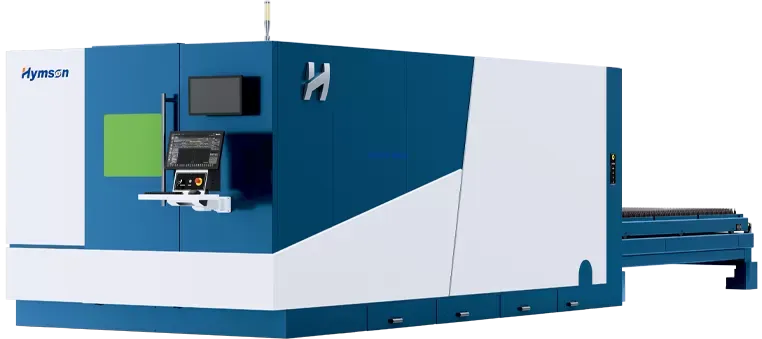
HyLaser 3216 PLUS is a 3200 × 1600 mm model for everyday sheet metal work, including batch manufacturing and frequent changes between jobs.
Key Features and Benefits
- Preset process library: Provides starting process settings, helping reduce repeated trial cutting and parameter adjustment.
- Integrated CAD/NEST workflow: Brings programming and nesting into a coordinated workflow to simplify preparation for new drawings.
- Multilingual interface: Makes interface use more accessible to operators working in different languages.
- Safety protection and monitoring: Combines collision protection with machine-status monitoring to support daily operation and help manage interruptions.
Considerations: Published series power is up to 6 kW. Material suitability and required cycle times need checking on representative parts. Its 11 m machine length also calls for a complete layout review.
Best fit: Shops with frequent drawing changes that place substantial demands on programming, trial cutting, and operator preparation.
Hymson HF-G-7X-3216 — Best for Flexible Power and Format Options
HF-G-7X-3216 is a 3200 × 1600 mm sheet-cutting model within a series offering several power and machine-size configurations for precision sheet metal work.
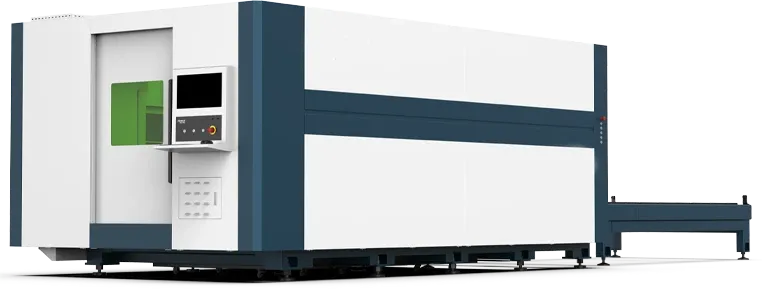
Key Features and Benefits
- Rigid bed and multi-point support: Help control vibration and structural deformation during processing, supporting dimensional consistency.
- Intelligent lubrication and air circuits: Support routine machine operation and help reduce maintenance-related interruptions.
- Cutting-head collision protection: Works with software and hardware movement limits to help manage operational interruptions.
- Zoned extraction: Combines negative pressure and enclosed air ducts to help control dust accumulation and routine cleaning requirements.
Considerations: The 3216 working area is fixed; other formats require different models. Its approximately 8.7 × 2.8 m body still needs additional space for handling, access, and auxiliary equipment.
Best fit: Shops comparing power options and installation layouts against their usual materials, part sizes, and production schedules.
Fiber Laser Cutters: Technical Comparison
The table makes differences in power range, motion specifications, and installation size easier to compare. Shared specifications also show where sample cutting and workflow demonstrations are needed to distinguish the machines.
|
Published specification |
HyLaser 3216 PRO |
HyLaser 3216 PLUS |
HF-G-7X-3216 |
|
Series laser power |
6, 12, 20 kW |
Up to 6 kW |
3–20 kW |
|
Maximum working area |
3200 × 1600 mm |
3200 × 1600 mm |
3200 × 1600 mm |
|
Maximum X–Y simultaneous positioning speed |
140 m/min |
140 m/min |
140 m/min |
|
Published maximum X–Y acceleration |
2.0 g |
1.5 g |
1.5 g |
|
X–Y positioning accuracy |
±0.03 mm/m |
±0.03 mm/m |
±0.03 mm/m |
|
Z-axis travel |
300 mm |
300 mm |
250 mm |
|
Maximum Z-axis speed |
72 m/min |
72 m/min |
Not specified |
|
Overall dimensions, L × W × H |
11000 × 2800 × 2350 mm |
11000 × 2800 × 2350 mm |
8700 × 2800 × 2200 mm |
|
Published specification |
HyLaser 3216 PRO |
HyLaser 3216 PLUS |
HF-G-7X-3216 |
Values are manufacturer-published specifications. Power availability and optional equipment need confirming for the proposed configuration. Positioning speeds describe axis motion; actual cutting times depend on the material, geometry, and process settings.
Which Fiber Laser Cutters Fit Your Production?
Representative orders provide a basis for connecting the technical comparison with the shop’s production requirements.
1. Order Mix and Preparation Time
Small-batch production may keep a machine occupied all day or account for only a few orders each month. Order quantity, changeover frequency, and monthly cutting hours clarify that difference.
When preparation dominates low-volume orders, PLUS deserves closer assessment.
Where many small batches create sustained daily cutting work, PRO’s process-control functions also merit comparison.
2. Material Range and Required Cut Quality
Routine grades, thicknesses, hole quality, and edge requirements establish the sample-cutting brief.
PLUS and HF-G-7X-3216 are candidates for thin- and medium-gauge sheet metal. Where trials indicate a need for more than 6 kW, PRO and higher-power HF-G-7X configurations extend the comparison.
3. Daily Output and Equipment Utilization
Required daily output and time spent cutting, loading, removing parts, and finishing show where capacity is constrained.
PRO warrants attention when continuous cutting and reduced intervention are priorities.
HF-G-7X-3216 can be assessed on the same parts to compare complete processing time.
4. Sheet Format and Installation Space
All three 3216 models remain candidates when their working area covers normal orders. Where installation length is restricted,
HF-G-7X-3216 offers a shorter published machine body.
Recurring larger-sheet work calls for comparison with HyLaser 4221 PRO/PLUS or a suitably sized HF-G-7X model.
Where requirements overlap, trials can compare total preparation, cutting, removal, and finishing time, together with yield and cost per accepted part.
Conclusion
Hymson Laser Machinery is worth considering for shops seeking both suitable cutting equipment and support with bringing it into daily production. Its range addresses different requirements for job preparation, cutting capacity, and installation space, while configuration advice, commissioning, training, and technical assistance support the equipment’s introduction and ongoing use.
For a comparison based on the parts you actually produce, contact Hymson Laser Machinery with representative drawings, material specifications, and daily output targets.
FAQs
- Which Fiber Laser Cutters Suit Low-Volume Orders?
HyLaser 3216 PLUS suits evaluation where frequent preparation dominates order time. HyLaser 3216 PRO is also worth comparing when numerous small batches create sustained machine use.
- Which Fiber Laser Cutters Should a Mid-Sized Sheet Metal Shop Compare?
Compare HyLaser 3216 PRO for sustained cutting and part-separation functions, HyLaser 3216 PLUS for frequent job changes, and HF-G-7X-3216 for power options and a shorter machine body. The choice depends on whether preparation, cutting capacity, or installation space creates the main constraint.
- Which Flatbed Laser Cutters Suit Thin- and Medium-Gauge Sheet Metal?
HyLaser 3216 PLUS and HF-G-7X-3216 are candidates. PLUS offers power up to 6 kW and a preset process library; the HF-G-7X series spans 3–20 kW. Sample cutting should confirm hole quality, edge finish, and processing time on the shop’s usual materials before selecting a configuration.
- What Is a Sensible Setup If Most of Our Sheet Metal Is Not Very Thick?
If routine sheets fit a 3200 × 1600 mm working area, compare HyLaser 3216 PLUS and HF-G-7X-3216. Select power through sample cuts on usual materials and daily output targets, with automation assessed against regular handling needs.
References
- ISO. ISO 9013:2017: Thermal cutting — Classification of thermal cuts — Geometrical product specification and quality tolerances.
https://www.iso.org/standard/60321.html